The global physical security market is forecasted to grow to $129.39 billion in 2026. That’s “billion” with a B. An increasing number of businesses are investing substantial capital in their security infrastructure. As AI-powered cameras, automated access controls, and predictive analytics flood the market, facility managers and decision-makers may start to question the value of human security guards in this automated world.
The reality is that safety isn’t a math problem you can code. Security is a human experience, and technology — no matter how advanced — cannot replicate the judgment, empathy, and adaptability that trained professionals bring to protecting people and property.
Security in the Age of Automation
Technology enables faster data analysis, quicker threat detection, and broader security coverage. For instance, AI-powered cameras monitor dozens of feeds simultaneously, while automated access control systems track real-time entry and exit patterns. Predictive analytics software also identifies vulnerabilities before incidents occur. These innovations make physical security operations more efficient and create valuable insights for facility managers.
However, the human element in security remains central to operations — human guards provide the contextual judgment necessary when threats emerge. While automation can handle data collection and pattern recognition, your facility needs someone to take action based on this data as well as alerts.
The Perception Gap: Are Guards Becoming Obsolete?
Security automation tools alone come with limitations. Power outages can shut down cameras, system glitches can trigger false alarms, and unique circumstances may require human judgment beyond technology’s original programming. Instead of making human security guards obsolete, automation tools are most effective when partnered with human expertise. Human guards excel in critical thinking and intuitive judgment, understand complex situations, and make informed decisions based on automation data.
Automation can’t replicate human security advantages. Intelligent decision-making capabilities become critical when seconds matter, and context determines the appropriate response. Professional security personnel make split-second decisions during crises by understanding each alert context. For instance, a fire alarm provides notification, but a security guard can:
- Determine safe exit routes.
- Assist people with mobility challenges.
- Coordinate with emergency responders.
Guards distinguish real threats from false alarms or nonthreatening anomalies that trigger automated systems. When a camera flags movement after hours, only a human can determine whether it’s an intruder, a cleaning crew working late, or a reflection creating a false positive.
Additionally, human security guards make fair, ethical, and appropriate judgment calls — especially in sensitive scenarios. For instance, in pediatric health care settings, security officers may need to handle contested custody disputes or court-ordered visitation restrictions with discretion, avoiding public confrontations that could cause the child’s emotional distress. Guards need to verify visitor identities and relationships while maintaining sensitivity to diverse family structures, such as foster care or joint custody arrangements.
These sensitive situations cannot be programmed within machines. What’s more, machines are also trained on past data and struggle with novel situations that have never occurred before.
Case Study: When Technology Alone Couldn’t Solve the Problem
When comparing the need for AI vs. human security guards, it helps to consider actual events. In June 2024, approximately 20 suspects robbed a jewelry store in Sunnyvale, California in just a few minutes, smashing display cases with hammers and fleeing before officers arrived. The surveillance system functioned perfectly, capturing the entire incident on video. However, the cameras remained passive observers — they could only record, not intervene.
The thieves understood this limitation and simply ignored the surveillance equipment. This case illustrates the flaw in a technology-only security approach for immediate, on-site crimes. While the footage provided evidence for investigation, it offered zero deterrence or prevention. A visible security presence could have deterred the attack entirely or enabled an immediate response to minimize losses.
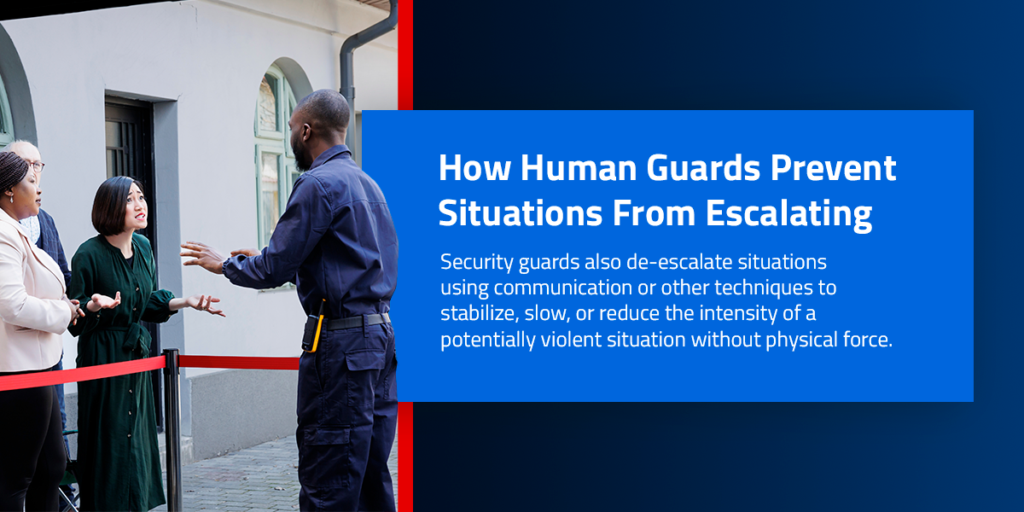
How Human Guards Prevent Situations From Escalating
Preventing incidents before they start is one of a security guard’s most effective advantages. The mere presence of a uniformed guard is a crime deterrent. Criminals are less likely to target locations with trained on-site professionals who can intervene immediately. This visible deterrence prevents incidents that would otherwise require emergency response.
Security guards also de-escalate situations using communication or other techniques to stabilize, slow, or reduce the intensity of potentially violent situations without resorting to physical force. Key techniques include purposeful actions, specific verbal communication, and conscious body language.
Training for Effective Conflict Management
De-escalation training involves three core components. Guards learn to:
- Recognize behavioral warning signs that indicate escalating tension.
- Assess whether a threat is present and how the individual might react.
- Employ purposeful actions to calm the situation before physical intervention is required.
The Customer Service Dimension of Modern Security
A guard’s role has evolved beyond traditional protection. Professional security personnel serve as an integral part of the customer and employee experience, creating lasting impressions of your facility.
First Impressions and Brand Representation
A professional, courteous guard represents your brand and enhances its reputation. The psychological impact extends beyond crime deterrence — a visible guard provides reassurance, making employees and customers feel safer and valued. This presence communicates that management prioritizes their well-being.
Guards welcome and direct visitors, answer customer inquiries, and set the tone for every interaction in the facility. This first impression shapes how clients, vendors, and guests perceive your organization’s professionalism and commitment to safety.
Balancing Security With Hospitality
Today’s guards provide hospitality with a badge, offering a reassuring nod or assistance to an anxious visitor — something a kiosk or camera can’t do. This dual role combines maintaining security through monitoring and access control with customer service through greeting visitors and answering questions. The balance creates a calm, welcoming environment where people feel safe and respected.
Services Beyond Protection
Guards can give directions, answer phone calls, take messages, and provide escorts when needed. Their uniform and presence create a perception of authority that encourages voluntary compliance with facility rules and policies. This expanded role delivers a greater return on investment than passive monitoring equipment. One security guard fulfills multiple functions that would otherwise require separate staff or remain unaddressed.
The Integrated Security Approach
The optimal security approach includes modern security technology and guards — combining human intelligence with AI’s logic and processing capabilities. An ideal security framework emphasizes planning, promoting, and implementing unified efforts across disciplines, including physical security, information security, and cybersecurity.
Technology handles large-scale data collection and continuous monitoring, freeing professional security personnel to focus on response, judgment, patrol, and customer interactions. In addition, modern security guard training includes proficiency with technology, ensuring these professionals can leverage automation tools effectively while maintaining the irreplaceable human judgment.
See What Human Guards Can Do for You
The Guard Alliance provides professional security guard services for every need — offices, commercial buildings, construction sites, apartments, or retail stores. With over 900 highly trained guards across more than 50 cities since 2010, we’ve protected 3,000 clients with the comprehensive coverage they require.
Our guards are available 24/7. Whether you need armed guards, unarmed guards, or specialized security services, our team delivers the human presence and professional judgment your property deserves. Contact us today to discuss your security needs.